 Wager Mage
Wager Mage
Wager Mage
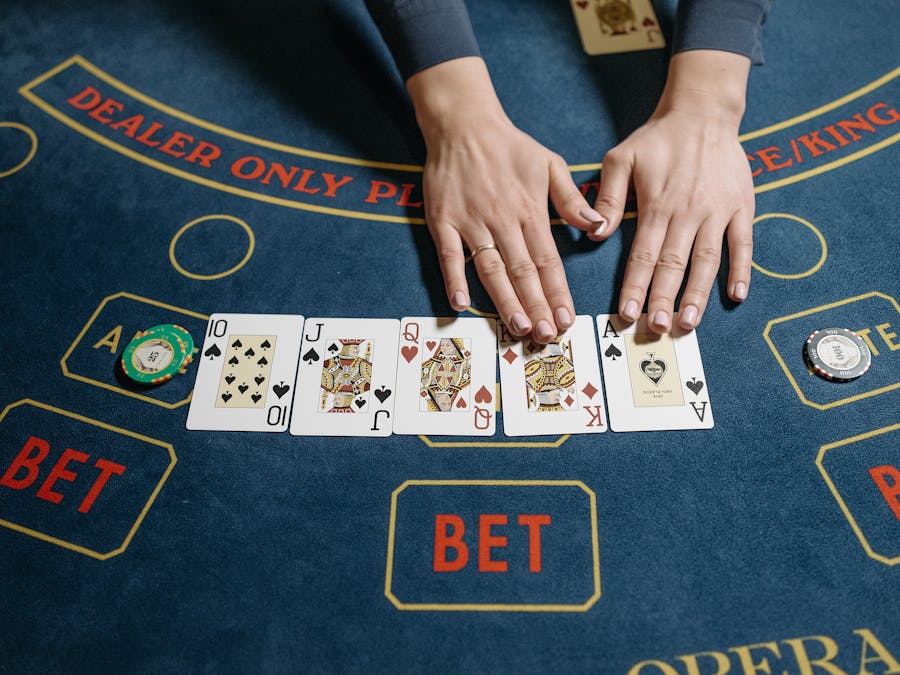
 Photo: Pavel Danilyuk
Luck is a factor in football. That unintentional handball adjudged to be a penalty, that deflection off the post, ball on the line — they turn games. Sometimes it's even quirkier.

Typical payouts for up to 10 team parlay bet Number Odds Amount won 7 Team Parlay 90 to 1 $9,000 8 Team Parlay 180 to 1 $18,000 9 Team Parlay 360...
Read More »
In poker, do you know what it means to cold call? It's the term used when someone, who doesn't have any money/chips invested in the pot, just calls...
Read More »The role of Luck in football? Quantifying the Quirky Luck is a factor in football. That unintentional handball adjudged to be a penalty, that deflection off the post, ball on the line — they turn games. Sometimes it’s even quirkier. Steven Gerrard’s “slip of the century” (Liverpool vs Chelsea) according to many cost them the title that year! But what is the role of luck? How big a factor is it? I investigate. Type of Luck Pots/draw Many competitions are draw based. If strong competitors are drawn in separate pots or if two strong rivals “cancel each other out” due the draw, a team can have an advantage. In the last World Cup, by finishing second in their group, England got what many believed was the easier half of the draw, avoiding heavyweights Brazil and France. They reached the semi-finals. Belgium on the other hand, despite getting the “harder side” of the draw also reached the semi-finals and beat England to third place as well. Despite the advantages of getting a favorable draw, we’ve often seen that teams going through stronger opposition actually do better. This is because they are forced to play at a higher level throughout. So while the draw plays a role, it’s impact is not always unequivocal. In the scheme of things, of all the sources of luck, this is perhaps the weakest, but a factor nevertheless. Refereeing decisions This is an important source of luck for a team. If a referee has missed an incident, it can prove pivotal. Recently, an offside goal was not called allowing Manchester City to advance in the FA Cup. Refereeing is difficult and in the fast paced game of today, plays can be genuinely missed by referees. It’s not intentional — and therefore becomes a lucky break. Underhand tactics (shirt pulling, sneaky push, diving etc.) can be used by players to deceive referees. If such play goes undetected, a team can benefit, many times significantly. Borderline foul play however is a double edged sword. As referees get more clued up and assisted by technology, they are able to spot and punish such deceptions. A penalty box dive now has a higher chance of earning a deserved booking rather than a penalty. With VAR, we can expect consequential actions to receive scrutiny. VAR only focuses on consequential events and by doing so it zeroes in on events that can turn games. In other words, the chance of lucky breaks available to teams due to an oversight by officials is reducing. Game plays This category includes the purest lucky breaks. Flukes, imbalance, slips, inadvertent own-goal, gilt-edge chances (either hit or miss), bouncing off the post (to to in or out), hitting the cross-bar, deflections, awkward bounce etc. This is pure luck and it’s effect on games is usually telling. Luck (definition) — success or failure apparently brought by chance rather than through one’s own actions.

MACD Crossover: Most Effective Bullish Indicators. Moving average convergence divergence, or MACD will provide both trends following as well as...
Read More »
Those that are 1971–1976 Chevy Caprices or Impalas are known as “donks.” Donks emerged in Miami in the early 1990s, according to Ree Sims, who...
Read More »Role of Luck The essence of training and preparation is to eliminate the element of chance or luck in execution. A better prepared team has many more things under its control and aims to not rely on luck. A normal player for example might have 50% free kick accuracy which may swell to 70% say with lucky breaks. An elite player will have 90% accuracy — regardless. The essence of preparation is to transcend luck, circumstance and contingencies in execution — to the maximum extent possible. Luck is a matter of preparation meeting opportunity — Seneca, Roman Statesman When teams are mismatched, luck plays a small role. Better ranked teams have enough quality to “mitigate” the “risks” of lucky breaks by the opposition. When the teams are equal, luck plays a bigger role. The closer the battle, the higher the prize, the bigger role luck can play. Using the analogy of the cake, skills, tactics and team organization is the cake. Luck is the icing. When the cake is similar, the icing can make all the difference. For equal teams, how big a factor can luck be? A study showed the average goals per game to be around 2.77 with the most common score line being 1–1 followed by 1–0. Anecdotally, in a typical game, as a rough estimate there are maybe 2–3 high profile events which materially sway the game (i.e. result in crucial goals scored / missed). In 90 minutes standard playing time, 2–3 events equate to around 2% to 3% of time. What's The Most Frequent Scoreline in Football History? Dutch data blog Sargasso has taken data from the Footballfans.eu site and compiled all results in football history to… www.balls.ie Based on that, 2%–3% estimation of luck as a factor seems to be in the ball park (no pun intended!). Cases of referee error leading to a goal, stoppage time lucky hit or miss, a fluky “1-in-1000” shot by a unheralded player or indeed a slip, which materially alters the outcome of a close and important game, are actually not very frequent. The luck factor can decrease further as technology decimates a big source of luck and non-sporting advantage on the field — referee oversight. The success rate of referees without VAR is 93% and with VAR it improves to 99%. As VAR is implemented in more games, one big type of luck (referee oversight) is nearly eliminated. That leaves us with lucky breaks to contend with, which will always remain. Overall, 2%-3% luck factor is a heuristic calculation but rings (reasonably) true. Indeed, a ceiling of 5% can be surmised for luck factor, in line with German World Cup winner Thomas Berthold’s thoughts on the matter. Probability and magnitude of impact though are two different things. When teams are mismatched, luck will usually never be enough to compensate (for the lower rated team). When the teams are equal, a 2%-3% or indeed a 1% chance even can be the difference between winning and losing. If that game is the World Cup Final, we enter the realm of the unquantifiable.

Parimatch is an international sports betting company in Europe with headquarters in Limassol, Cyprus, founded in 1994.
Read More »
Natural Consequences: Natural consequences are the best form of positive punishment because they teach your children about life. Natural...
Read More »
Although whether a number is prime or not is pre-determined, mathematicians don't have a way to predict which numbers are prime, and so tend to...
Read More »
Go into “privacy” to change what certain users can see. In the “privacy” page, tap on “blocked accounts” to view the profiles that you have...
Read More » Promotion
 Promotion
 Promotion